


What Steel Frames Bring to a Modern Home Build
Steel frame homes still need a bit of explaining in Australia.
That’s not because steel is strange or untested. It’s because timber has been the familiar framing material for generations, and it’s still what most people picture when they think of a home frame.
And that’s fair enough.
Timber can be a good building material. Good timber builders can build excellent homes. Steel isn’t here because timber is wrong.
The better question is this: what does steel bring to a modern home build?
For Australian family couples who are smart about their investment in their family home, it’s worth understanding the answer.
Steel vs timber isn’t about right and wrong
This isn’t a simple steel good, timber bad discussion. Both steel and timber can work well when they’re designed, detailed and built properly. The Australian Government’s guide explains that lightweight framing using timber or steel is the most common form of framing used in Australian homes.
So the frame is only one part of the full home.
Good insulation still matters. Good weatherproofing still matters. Good workmanship still matters.
The real issue is whether steel suits the type of home being built, the builder’s process, and the long-term performance the customer is looking for.
Steel brings consistency
One of the big advantages of steel framing is consistency. Steel doesn’t shrink, twist or warp in the same way timber can when moisture and temperature change.
For a home buyer, that can mean straighter walls, squarer corners and a cleaner finish.
That matters in any home, but it matters even more in a modular building process where the home is being built through a controlled system. The more consistent the frame, the easier it is to build accurately around it. Timber can still be built well, but steel gives the builder a stable starting point.
Steel suits modern manufacturing
Steel works well with modern building systems because it can be digitally designed, manufactured and assembled with a high level of accuracy.
That’s one reason some modular builders prefer it. In a factory environment, repeatability matters. You’re not trying to make it up as you go. You’re trying to build accurately and consistently.
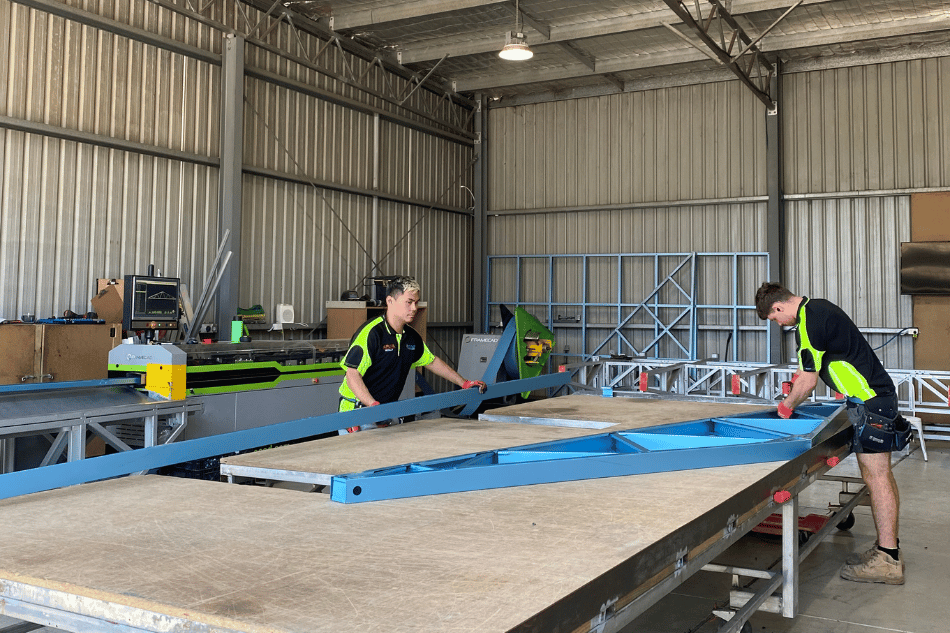
Manor steel frames are made using a computerised steel framing machine, which helps with speed, accuracy and reduced wastage compared with the timber framing process previously used.
Steel isn’t just a material choice. In the right setting, it becomes part of a more controlled building process.
Steel helps with termite peace-of-mind
Termites are a real concern in many parts of Australia, especially in rural, regional and bushland settings. Steel itself isn’t a food source for termites, which gives it an obvious advantage for the structural frame.
However, it’s important not to overstate this. A steel frame doesn’t mean you can forget about termite management altogether. YourHome notes that a steel frame doesn’t remove the need for termite protection to the home.
That’s because a home can still include other materials, finishes, flooring systems, cabinetry and site conditions that need proper attention.
So the balanced way to say it is simple: steel helps reduce termite risk to the structural frame, but the whole home and site still need sensible termite protection.
Steel can support a durable home
Durability is one of the main reasons some builders choose steel. Steel framing can provide long-term stability and strength when it’s properly engineered, protected and installed.
Steel framing has greater durability in termite-prone areas and is highly recyclable. Also, steel has higher embodied energy than timber, can be more expensive, and needs protection in corrosive environments.
That’s the honest version. Steel has strong advantages, but it still has to be used properly.
In coastal areas, harsh climates or exposed locations, the coating, detailing and broader building system all matter.
No building material should be treated as bulletproof without the right design behind it.
Steel can reduce waste in a factory setting
Waste is another practical consideration. In a controlled factory environment, steel framing can be planned, cut and assembled with a high degree of control.
Steels offcuts are collected and recycled, and that the shift to steel reduced the volume of offcuts compared with timber. Again, this needs to be said carefully. Timber from responsible sources has genuine environmental benefits. Timber has low embodied energy and stores carbon during growth, while steel has higher embodied energy but is highly recyclable.
So it’s not as simple as saying steel is always the more sustainable choice. The better question is how the whole system performs.
How much waste is created? How much rework is avoided? How long will the structure last? How well is the home insulated?
Those questions matter more than a slogan.
Steel isn’t perfect
This is worth saying plainly. Steel has drawbacks.
It can conduct heat, so thermal breaks and insulation need proper attention. It needs the right protection and detailing in corrosive environments. Some trades are more familiar with timber.
It can also cost more in some situations, depending on the design, fixings, supply chain and builder’s system.
So if a builder uses steel, they need to understand steel. They need to know how it fits into the full wall, roof, insulation and cladding system.
The frame doesn’t perform on its own. It performs as part of the home.
Why some builders choose steel anyway
Even with those considerations, many builders choose steel because the advantages suit their building process.
Steel can support consistent framing, straighter walls, strong dimensional accuracy, termite resistance in the frame, efficient factory production and reduced frame movement over time.
For builders using modern methods of construction, those advantages can be significant. They help reduce uncertainty, support a more disciplined process and create a durable build with a more predictable outcome.
That’s why steel often makes sense for a modern modular home.
What should you ask about steel frame homes?
If you’re comparing builders or building systems, don’t just ask whether the frame is steel or timber.
Ask better questions.
- Why do you use steel for this type of home?
- How is the frame engineered?
- How do you manage thermal bridging?
- What coating or protection does the steel have?
- How does steel work with your wall and roof system?
- What termite protection is still required for the rest of the home?
These questions will tell you more than the material label alone.
A clear answer usually points to a clear process.
So, what does steel bring to a modern home build?
Steel brings consistency, strength, accuracy and termite resistance to the structural frame.
It suits factory-based construction because it works well with digital design, controlled manufacturing and repeatable systems.
It can also support a durable, low-maintenance home when it’s used properly as part of a complete building system.
But steel doesn’t make timber wrong. And steel doesn’t replace the need for good design, good detailing and good workmanship.
The best way to think about it is simple.
Steel doesn’t make a home good by itself.
But in the right hands, and as part of a proven process, it can help a good builder build with more control.
For families investing in a home they want to enjoy for years, that matters.