


Flood Resistant Homes: How Smart Home Design Protects Australian Families
Flood resistant homes matter most when you’re rebuilding after a flood. You don’t want gimmicks. You want a home set up properly. It needs the right height, real strength, and sound judgement. And while repairs may still happen, the structure should stand firm.
Flooding across parts of Queensland and New South Wales keeps returning. So, families are forced to make big decisions under pressure. That’s tough. However, a calmer plan leads to better outcomes.
Increasingly, Australian family couples who are smart about their investment in their family home ask better questions upfront. They focus on safety first. Then they focus on durability. Finally, they focus on long-term liveability.
The real goal of flood resistant homes
The goal is not a “house you can hose out”. That idea rarely matches reality. Instead, the goal is simple.
You want a safe place to live. You also want fewer catastrophic surprises. As a result, the rebuild should prioritise levels, structure, and site conditions.
In other words, start outside the home. Start with how it sits on the land.
Myth: “Just put the house on stumps”
After a flood, people want a clear solution. That’s normal. But “stumps” alone are not a strategy.
A raised floor can help. However, it only works when the whole system is right. That includes:
- correct finished floor level
- correct footing design for the soil
- proper bracing and tie-downs
- sensible planning for water flow and debris
So, think “system”, not “feature”.
Finished Floor Level (FFL) and AHD, explained simply
You’ll often hear two terms.
- Finished Floor Level (FFL) is the height of the habitable floor. It’s where you live.
- AHD is a national height reference. It helps describe levels on a site.
So when council says “your FFL must meet a nominated AHD”, they mean this:
Your living floor must sit at a specific height. That height reflects flood risk rules for that area.
Why height is often the first big decision
Getting the height right is a major win. It can reduce water entry to living areas. It can also protect the most expensive parts of the build.
In addition, a raised home can create practical space below. That might include storage or parking. Even so, those benefits are secondary. Safety comes first.
Most importantly, the height must match the site’s flood behaviour. It also needs to meet local requirements.
Two rebuild examples that show “smart setup”
These examples show what “flood thinking” looks like in practice.
Example 1: Beside a lake, with a high FFL requirement
A family purchased a knockdown rebuild beside a lake. Council required a high finished floor level. The home needed to sit well above the ground.
So, the design embraced the height. They raised the home further. They then used the under-house area for vehicle and general storage. As a bonus, the home gained stronger lake views.
Key takeaway: compliance was the baseline. Smart design made the height work harder.
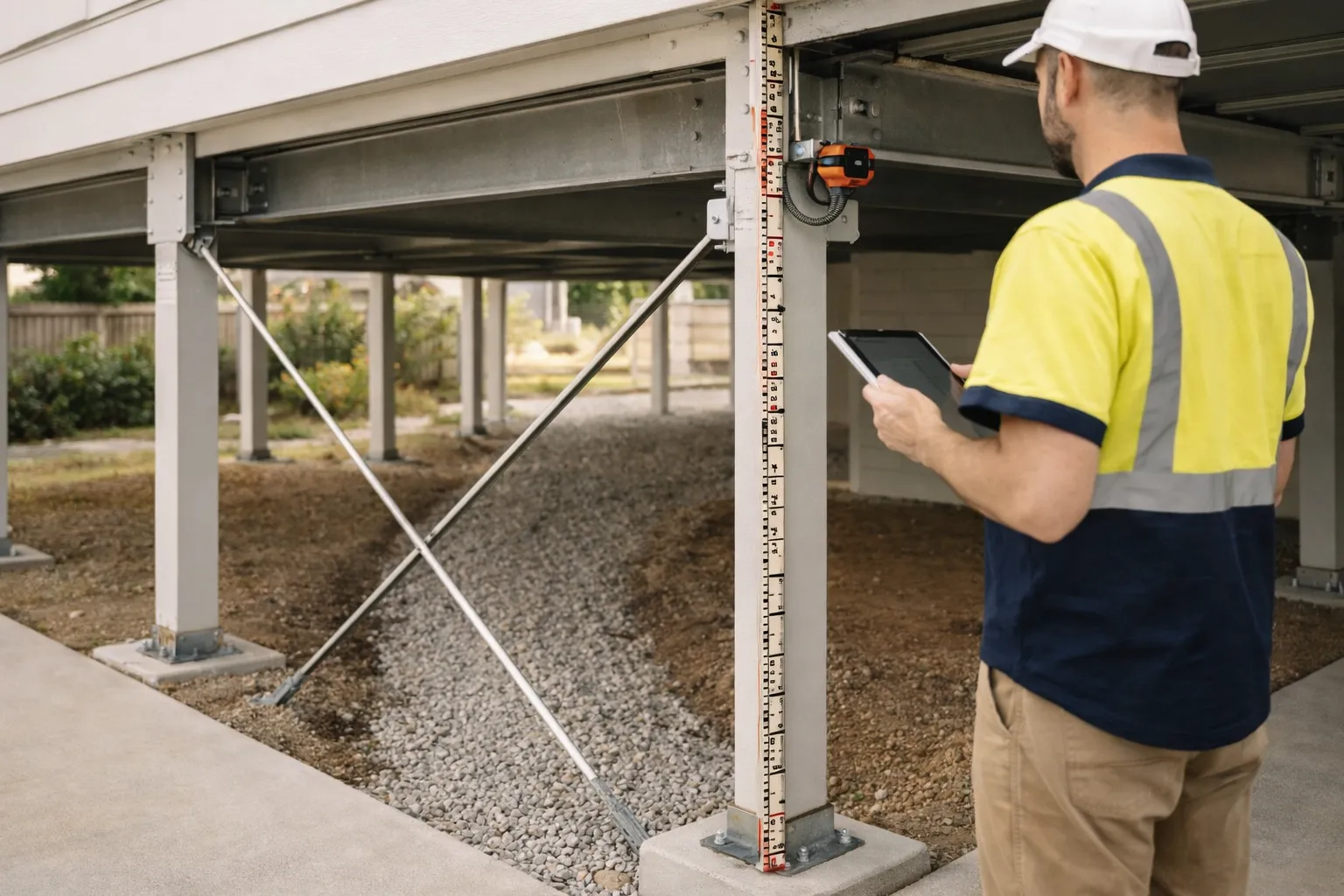
Example 2: Hillside rebuild with stumps and clean finishing
Another home sat on a sloping hillside. The flood-related levels still affected the design. The home needed clearance off the ground.
So, the build used stumps with proper bracing. Then the landscaping finished it properly. As a result, the home looked intentional, not temporary.
Key takeaway: elevation can look excellent. But it needs structure and finishing to match.
What “doing it properly” actually involves
If you’re rebuilding, keep these fundamentals front and centre.
1) Get the right floor height, for the right reason
Ask what level applies to your block. Ask who sets it. Then ask how it was determined. After that, make sure the design meets it cleanly.
2) Treat footings as engineering, not guesswork
Flood-affected land can change. Soils shift. Saturation happens. Erosion can also occur. Because of that, footing design needs serious attention.
3) Plan for moving water and debris
Depth matters. However, moving water can be worse. Debris impact can also do major damage. So, structure and clearance should suit the site’s reality.
4) Design the under-house zone on purpose
If the home is raised, you’ll have space underneath. Plan it deliberately. Consider access, drainage, and what’s safe to store there. Also consider how it will look when finished.
Due diligence questions worth asking any builder
This isn’t about who you build with. It’s about building wisely.
Ask these questions early:
- What flood information applies to this block?
- What finished floor level is required, and why?
- What flood type is relevant here (river, overland flow, flash)?
- How will the footing and bracing system handle site conditions?
- What’s the plan for water movement under and around the home?
- How will the design be finished, so it looks intentional?
- Can you explain the “why”, not just the “what”?
Final thought: trust matters, and experience matters
Rebuilding after a flood is exhausting. So, it’s easy to latch onto one idea. “Stumps.” “Modular.” “Raised floor.” However, one feature won’t carry the whole outcome.
That’s why Australian family couples who are smart about their investment in their family home (style and value) focus on fundamentals. They do due diligence. They seek clear explanations. And they choose a builder they can trust.
A good rebuild won’t promise flood-proof living. Instead, it will deliver a stronger home. It will also deliver clearer decisions. Most importantly, it will deliver confidence.