


The River Series is now available with our new Modern Coastal façade – designed for flood-prone and coastal blocks. | Enquire Now
Steel Frame vs Timber Frame: Which Is Right For You?
Steel frame vs timber frame is one of the biggest decisions you’ll make when building a new home. Your frame affects straightness, durability, comfort, and long-term maintenance. It also shapes how well the rest of the home performs.
Both options can deliver an excellent home. However, the best choice depends on your priorities, your site, and your builder’s system. That system includes insulation, membranes, sealing, ventilation, and moisture control.
It’s why Australian family couples who are smart about their investment in their family home don’t just ask “steel or timber?” They ask what will stay straight, comfortable, and reliable for decades.
Steel frame vs timber frame: at a glance
| What matters | Steel frame | Timber frame |
| Termites | Steel isn’t a food source for termites. This removes a major structural risk. | Timber can be vulnerable if protection fails. Risk varies by region. |
| Straightness + stability | Manufactured sections stay consistent. That helps reduce movement over time. | Timber can shrink, swell, or twist with moisture and time. |
| Moisture resilience | Steel performs well when kept dry through good detailing. Correct coatings suit different environments. | Timber performs well when kept dry. However, chronic wetting can lead to rot. |
| Comfort + energy | Steel needs thermal-bridge management in the wall system. Good builders design for it. | Timber is less conductive than steel. Thermal bridging is usually lower. |
| Sustainability | Steel is widely recyclable. Waste can be reduced with controlled manufacturing. | Timber is renewable and can store carbon. Sourcing matters. |
| Precision (especially modular) | Steel suits engineered, repeatable fabrication. This supports high consistency. | Common in conventional builds. Accuracy depends more on site conditions. |
Start with your non-negotiables
First, decide what matters most to you. This makes the choice much easier.
For example, you might care most about:
- termite risk
- long-term straightness
- thermal comfort
- sustainability
- coastal or high-humidity conditions
- future renovation plans
Next, rank your top three. Then compare the frame options against those priorities. You’ll usually see a clear winner.
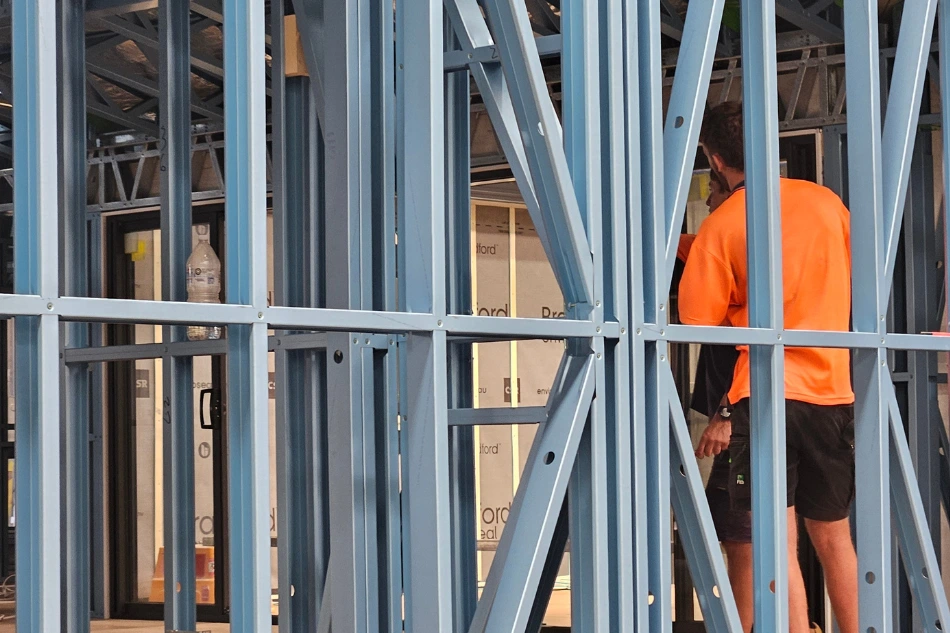
Why many builders and homeowners choose steel framing
1) Straight walls and long-term consistency
Steel is manufactured to consistent dimensions. That consistency helps keep lines straighter over time. As a result, doors, cornices, and cabinetry tend to stay better aligned.
This matters more than most people think. You live with those “small” details every day.
2) Termites don’t attack the frame
Termites are a reality in many parts of Australia. Steel removes timber framing from the equation. That’s one less structural risk to manage.
You still need good site practices. However, the frame itself isn’t a termite food source.
3) Designed durability through proper specification
Steel framing is designed with protective coatings. Those specifications change with the environment. Coastal locations, for instance, need different considerations to inland builds.
In other words, durability is not luck. It’s specification plus good detailing.
When timber framing can be the right choice
Timber has built Australia for generations. It remains a strong option in many contexts.
Timber can suit you if:
- you want a widely used, familiar system
- you have a strong termite management plan
- you’re working with a builder who details moisture control well
- you want a pathway that suits future changes
Most importantly, timber performs best when the home stays dry and well ventilated. That’s true for any frame type.
Comfort and energy efficiency: the frame isn’t the whole story
Comfort comes from the whole building envelope. That includes insulation, sealing, glazing, shading, and ventilation.
Steel is more conductive than timber. So, steel frames can create thermal bridges if the wall system ignores them. Australia’s NCC guidance calls this out.
The good news is simple. Builders manage thermal bridging with the right wall assemblies. NatHERS guidance also explains how thermal bridging is treated in assessments.
So, don’t ask only “steel or timber?” Also ask, “what wall system are you using?”
Durability over time: what really drives performance
A durable home stays dry, stable, and well detailed. The frame material matters. However, workmanship and design matter just as much.
For steel framing, coating and environment specification are part of compliance.
For timber framing, termite and moisture strategies are crucial, especially long term.
Therefore, the best question is practical: “How does this builder manage moisture and ventilation in the envelope?” A builder who answers clearly is usually a safer bet.
What about cost?
Costs vary by region, design, and market conditions. So, blanket statements rarely help.
Instead, compare value:
- inclusions and finish level
- energy performance
- wall systems and insulation
- durability detailing
- the builder’s proven process
In addition, ask what is included in the quote. Then compare like for like.
What to ask your builder: a simple checklist
Use these questions with any builder. They’ll tell you a lot.
- Why do you use steel or timber for this design?
- What wall system are you using, and why?
- How do you manage thermal bridging in that wall system?
- How do you manage condensation and moisture control?
- If it’s steel, what coating/spec suits this environment?
- If it’s timber, what termite strategy is included, and how is it maintained?
- What insulation values do you typically deliver in walls and roof?
- Can I see examples you built 5–10+ years ago?
- What’s included that affects comfort, like glazing and sealing?
- If I renovate later, what should I know about this frame?
Meanwhile, pay attention to how they answer. Clear answers usually signal a strong process.
Bottom line: choosing with confidence
Choose steel framing if you want consistency, termite resistance, and a highly engineered approach. Choose timber framing if you want a traditional pathway and you have strong termite and moisture management.
Either way, quality comes from the full system. That includes detailing, sealing, ventilation, and a builder who can prove results.
In practice, Australian family couples who are smart about their investment in their family home look past the noise. They focus on what drives long-term performance. That’s good design, correct detailing, and a builder with a proven track record.