


The River Series is now available with our new Modern Coastal façade – designed for flood-prone and coastal blocks. | Enquire Now
The Truth About Modular Home Weight: Too Heavy, Too Light, or Just Right?
When you picture a modular home being delivered, you might imagine it’s either surprisingly heavy — too much for a truck to handle — or suspiciously light, like a box that might not stand up to Australian conditions. The reality sits somewhere in between. And for many future homeowners, understanding the real weight of a modular home helps answer important questions about strength, safety, and transport.
In this blog, we’ll explore how much a typical modular home module weighs, what contributes to that weight, and how it all works — from the truck and crane to the final placement on site. Whether you’re early in the process or just starting to wrap your head around modular construction, this will give you the facts to feel confident about the journey ahead.
What Makes a Modular Home Module Heavy?
Let’s start with what we’re actually talking about here.
This isn’t a kit home or a panelised system. We’re referring to modular homes built in fully-formed sections, known as modules. These are sometimes called volumetric modules, meaning they include complete walls, floors, roofs, internal finishes, glazing, cabinetry and more — all built off-site and transported in large, enclosed sections.
Now, onto the question of weight.
A modular module may look like a solid object, but it’s mostly air. Inside the walls, ceilings and floors, the structure is hollow — just like any standard house. That air doesn’t weigh anything, and that’s key to understanding why these modules are not as heavy as some people expect.
But they’re not lightweight or flimsy either. In fact, the modules are packed with everything needed to make them solid, durable and ready to live in. Here’s what contributes to the weight:
- Light gauge steel framing
These aren’t timber frames. We use light gauge steel in both the walls and roof trusses, which is strong, stable, and engineered for load without unnecessary mass. - Cladding and roofing materials
Depending on your finish selections — like weatherboard, metal cladding, or fibre cement — the external skin adds both durability and weight. Roofs typically include metal sheeting, insulation, and battens. - Insulation and wall linings
Inside, plasterboard, ceiling panels and insulation give the module both comfort and structure. - Windows and doors
Large glazed panels and double-glazed windows can be heavy — especially when framing is aluminium or extra-wide. - Joinery, kitchen and bathroom fittings
Benchtops, sinks, cupboards, tile layers and even bathtubs all add concentrated weight, particularly in wet areas. - Flooring and underlay
Timber, tiles or carpet layers all contribute — including the fixings, adhesives and support structure beneath them.
Despite these components, a lot of the volume in a module is hollow space: rooms, wall cavities, ceiling voids. That balance — solid where needed, open where possible — is what makes these homes both light enough to transport and strong enough to live in.
So, What’s the Actual Weight?
Most full-sized modules will weigh somewhere between 7 and 12 tonnes — that’s 7,000 to 12,000 kilograms. To put that in perspective, that’s the weight of about 5 to 8 small cars.
How heavy a module is depends on several factors:
- The size of the module (length, width and height)
- How steep the roof pitch is
- The type of cladding or external finishes
- Whether it includes a kitchen or bathroom (which are heavy zones)
- The type and quantity of internal finishes (like tiles, stone benchtops, or large windows)
Here’s a quick overview of typical weights:
| Module Type | What’s Inside | Typical Weight |
| Small bedroom or living space | No wet areas, minimal cabinetry | ~7–8 tonnes |
| Standard module with kitchen and bathroom | Full fit-out, tiled floors, standard finishes | ~9–11 tonnes |
| Large or premium feature module | High-end materials, large windows, stone finishes | ~11–12+ tonnes |
So if your home includes three or four modules, the total transported weight might sit around 30–40 tonnes across multiple truckloads.
It’s worth noting that many Australian family couples who are smart about their investment in their family home — balancing both style and value — are choosing this kind of modular construction precisely because it offers the right mix of strength, weight and flexibility.
But Isn’t That Too Heavy for a Truck?
It’s not.
In Australia, a typical six-axle semi-trailer combination (truck and trailer) is legally allowed to carry a combined total of up to 42.5 tonnes — and that’s excluding oversize permits, which modular homes often travel under. So a 10 or 11-tonne module is a routine load.
Transport trucks used for modular homes are built to carry these kinds of weights safely and legally. The load is spread across multiple axles, and the trailers often include hydraulic steering or custom supports to keep everything stable. These aren’t off-the-shelf trucks — they’re built for the job.
So if you’re worried the modules are too heavy to move, rest assured: they’re well within what Australian roads and trucks are designed to handle.
Or Is It Too Light to Be Strong?
Also no.
Some people expect a modular home to feel “light” because it’s prefabricated. But these aren’t portable buildings or caravans. They’re built to meet the same structural codes and engineering standards as site-built homes, with framing, fixings, and bracing designed to stand up to the Australian climate.
And here’s the key: strong doesn’t have to mean heavy.
Our use of light gauge steel framing means modules are structurally rigid without relying on bulk. Engineering plays a bigger role than mass here. Walls are braced and supported correctly. Roof trusses are tested for loads. And once installed, the modules are fixed to prepared footings or stumps that are rated for their specific weight.
Even though the modules aren’t excessively heavy, they’re designed to be strong in all the ways that matter — for transport, for lifting, and for life.
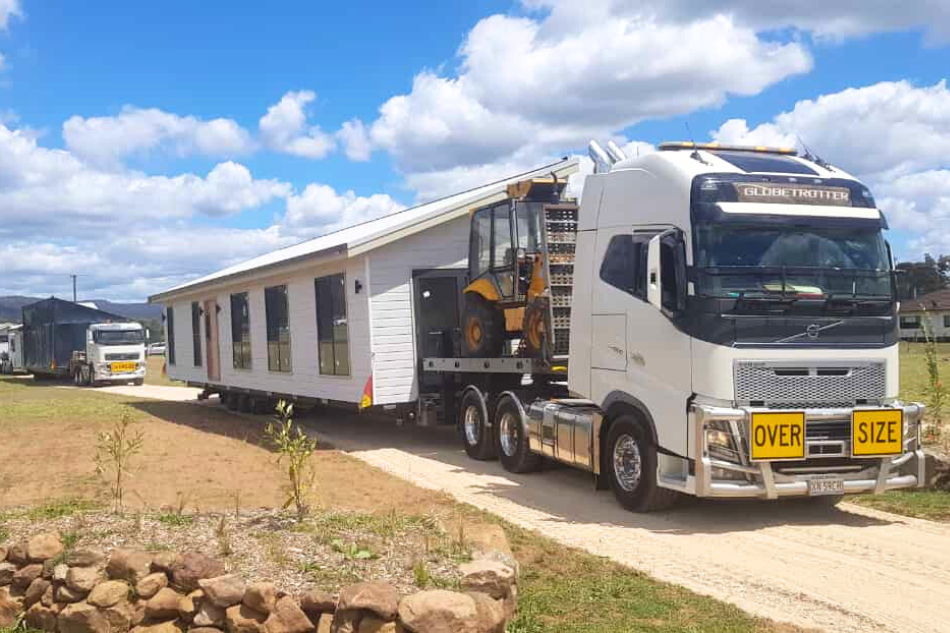
What Happens When Modules Are Moved?
Transporting modular home modules is a precise process — not improvised, not rushed, and not left to chance. Here’s how the system works:
- Planning comes first
Each route is mapped and approved. That includes checking for road width, bridge clearance, load limits and turn angles. If permits or escorts are needed, they’re arranged before the move. - Lifting is managed by professionals
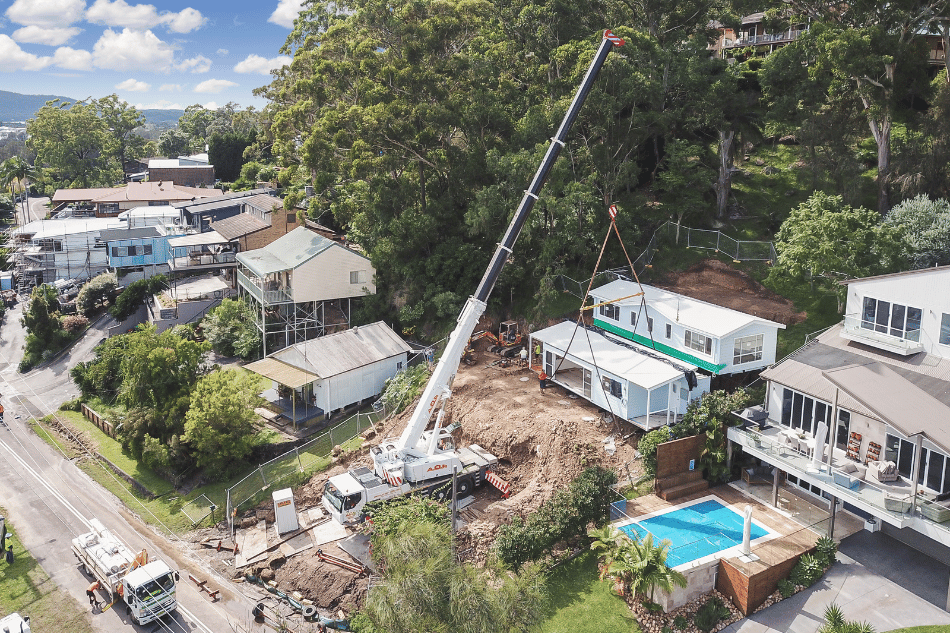
Modules are craned into place, or wheeled into position on-site using gear rated far above the module’s weight. It’s a routine manoeuvre — even at 12 tonnes — thanks to pre-planned lifting or drawbar points and structural allowance. - Foundations are matched to the load
Every home’s footings or stumps are engineered based on the weight and design of the modules being installed. There’s no guesswork involved — it’s designed to work from the start. - Weighbridge checks confirm actual weight
From time to time, modules are weighed during transport — and what they show matches what we expect: modules typically land right in the 7–12 tonne range, depending on what’s inside.
A Quick Recap — For Anyone Still Wondering
Let’s sum it up simply:
- Modules usually weigh between 7 and 12 tonnes
- That’s well within what a semi-trailer in Australia can legally carry
- The modules are strong because of their design and framing, not their mass
- Most of the volume inside is just air — you’re not hauling a solid block
- They’re engineered to handle transport, craning and installation — safely and reliably
It’s no surprise that many Australian families looking to build smarter, not just bigger, are choosing modular for the peace of mind it offers — a home that’s carefully balanced between strength, efficiency, and comfort.
Building with Confidence
At the end of the day, choosing a modular home is about trusting the process — from the way each module is built to how it’s delivered and installed.
And thousands of families across Australia have already taken that step, watching their home arrive in sections and take shape in a matter of hours on site. It’s not magic. It’s just smart, well-engineered design.
If you’d like to learn more about how it works — from construction to installation — visit www.manor.net.au and explore what’s possible.
Building Stories, Crafting Homes — that’s what we do, one module at a time.